

Car insurance and your credit scores should be two separate issues.
Unfortunately, it has become a common practice for auto insurance companies to pull consumers’ credit reports. Bad credit may result in higher premiums or even a denial of insurance.
In the past insurance companies considered driving record, age, type of automobile and the number of insurance claims to determine who to insure.
Nearly all auto insurers use a credit scoring system called an “insurance risk score” as a predictor of risk unless you live in California, Hawaii, Massachusetts, Michigan, and Washington, where the practice has been banned.
Insurance companies believe the better someone’s credit score the least likely an insurance claim will be made – and the more likely insurance premiums will be paid.
Decisions based on insurance scores
An insurance company can approve or deny automobile insurance based on your insurance score, even if you have a spotless driving record and never had an at-fault automobile accident.
The insurance company can also raise your insurance premiums based on their credit scoring model. Driving records have become secondary to determining the cost of insurance premiums.
Why your Credit History Matters
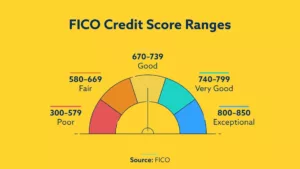
Consumer credit scores range from 300 to 850. A higher credit score signals that a borrower is lower risk and more likely to make on-time payments.
When an insurance company pulls your credit history they are looking for predictor items associated with credit management patterns. These patterns supposedly correlate with insurance risk.
The predictors are:
- Outstanding debt
- How long you have utilized credit
- Late payments
- Public records such as bankruptcy
- Collection items
- New credit applications
More emphasis is put on credit activities occurring in the last 12 months. The insurance industry’s belief is that insurance scores predict the average claim behavior of a group of people with essentially the same credit history.
A consumer with a good score, typically 760 and above, is least likely to file an insurance claim. While consumers with a bad score, typically 600 and below, tend to file more claims.
According to Progressive, insurance scores range from 200 to 997, with everything below 500 considered a poor score, and everything from 776 to 997 considered a good score.
A standard scoring model does not exist
Some insurance companies use a scoring model created by ChoicePoint and Fair Isaac Corporation, the company that invented credit scoring. Other insurance companies have designed their own scoring models.
A standard scoring model does not exist. Each insurance company uses different models and weighs different data in a consumer’s credit report.
What is standard in insurance credit scoring are particular factors that are not considered. According to the Insurance Information Institute (III), credit-based insurance scores don’t factor in:
- Your job
- Income history
- Gender or any other personal information
Credit reports contain errors
It has been well documented that credit reports can contain errors that can be serious enough to result in a denial of credit.
But it seems the insurance industry is looking for a reason to charge higher rates. They don’t care about the accuracy of credit data.
Even more sinister is the fact that insurance company practices end up hurting specific groups of people. For instance, several studies have shown that insurance scoring adversely affects African Americans, Hispanics, and low-income consumers. A nationwide study by the Consumer Federation of America in 2015 found that predominantly African-American neighborhoods pay 70 percent more, on average, for premiums than other areas do.
Steven Parton, general counsel for the Florida Office of Insurance Regulation, says, “What they’re really looking to see with insurance scores is who is most likely to file a claim, not who will most likely have an accident.
If I have the money, I won’t file a claim, because my rates will go up. People of low economic status don’t have that luxury.” Parton adds, “Insurance companies are looking at whether they’re relying on their insurance in case they have an accident, which is what they’re buying insurance to begin with.” (ConsumerReports.org)
Notification if Denial is based on Credit
Insurance companies must disclose to consumers they are using credit information in the underwriting process and to determine rates.
If a consumer’s credit score is the determinant in rejecting an application for insurance or another adverse decision, the consumer must be notified. Anyone denied insurance based on a credit report can get a free copy of their credit report.
Learn how to successfully dispute credit errors.